
Strength for Real Life: Carry, Reach, Step, and Rise
Train four real-life movement patterns after 60 with safe exercises for carrying, reaching, stepping, and rising from a chair.

I'm interested in strength for a very specific reason.
I want it to help me do things.
Carry groceries.
Put something on a shelf.
Step onto a curb.
Get up from a chair.
Those movements aren't glamorous.
But they're exactly the kinds of things that allow us to continue navigating our own lives independently.
So today's workout isn't built around body parts.
It's built around four things we actually do:
Carry. Reach. Step. Rise.
1. CARRY — Balanced Carry
The real-life task
Groceries.
Shopping bags.
Laundry.
Packages.
The exercise
Hold one light object in each hand.
Small dumbbells work.
So do evenly filled reusable bags.
Stand tall with your shoulders relaxed.
Walk slowly across a clear room for 20–30 seconds.
Turn carefully.
Walk back.
Common mistake
Choosing loads that are so heavy your shoulders round or your body leans.
If your posture changes dramatically, lighten the load.
Make it easier
Carry lighter objects or walk for less time.
Make it harder
Gradually increase the walking time before increasing the weight.
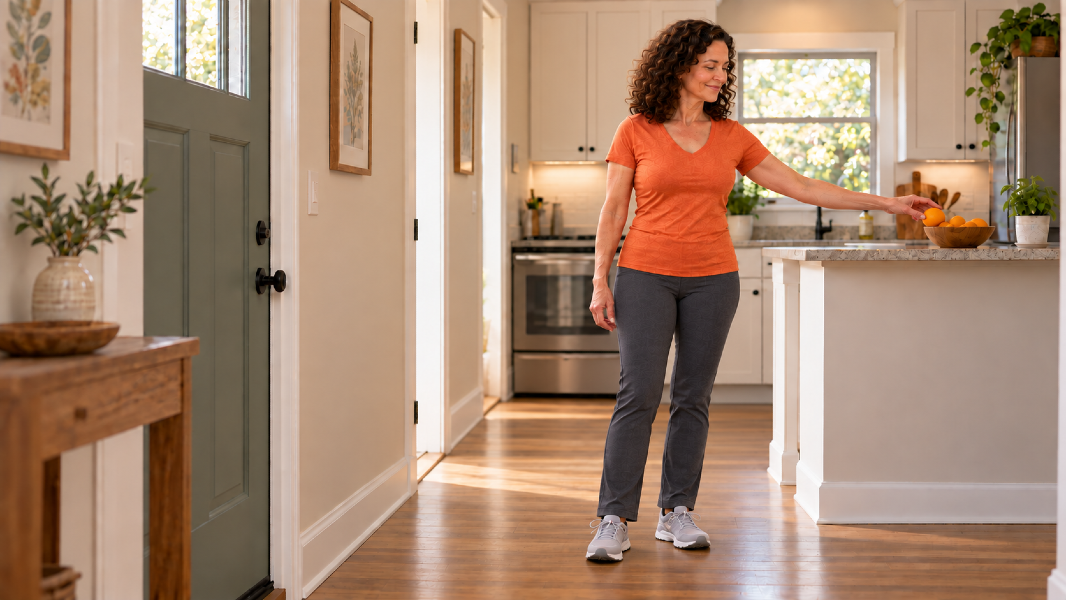
2. REACH — Wall Reach With a Light Object
The real-life task
Putting away dishes.
Reaching into cabinets.
Placing something on a shelf.
The exercise
Stand facing a wall with your feet comfortably apart.
Hold a very light object with both hands.
Raise it toward a comfortable target on the wall.
Return it slowly to chest level.
Repeat 6–8 times.
Your goal isn't to reach as high as humanly possible.
Stay within a comfortable shoulder range.
Common mistake
Arching the lower back to create extra reach.
Keep your ribs and torso controlled.
Let the shoulders do the reaching.
Make it easier
Reach to a lower target or don't use an object.
Make it harder
Increase repetitions before increasing weight.
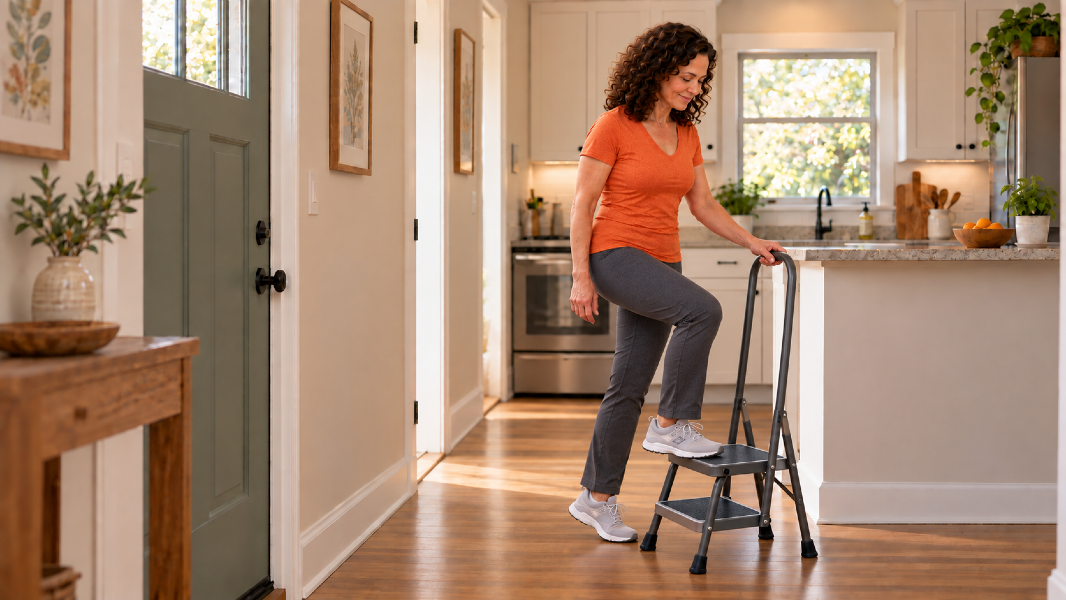
3. STEP — Low Step-Up
The real-life task
Curbs.
Stairs.
Trail steps.
Getting into raised entrances.
The exercise
Use a low, stable platform.
Have a railing, counter, or other secure support immediately available.
Place your whole foot on the step.
Press through that foot and step up.
Return slowly.
Complete 5–8 repetitions per side.
Common mistake
Using momentum and pushing aggressively from the back foot.
Think about the leg on the step doing the work.
Make it easier
Use a lower step and hold the support.
Make it harder
Add repetitions before increasing the step height.
4. RISE — Sit-to-Stand
The real-life task
Getting out of a chair.
Getting up from the table.
Getting out of the car.
Getting off the toilet.
The exercise
Sit near the front of a sturdy chair.
Place your feet firmly on the floor.
Lean your torso slightly forward.
Press through your feet and stand.
Pause.
Lower yourself back down with control.
Complete 6–10 repetitions.
Common mistake
Dropping quickly back into the chair.
The lowering portion counts.
Control it.
Make it easier
Use the chair arms or place your hands on your thighs for assistance.
Make it harder
Use less hand assistance — not a dramatically lower chair.
Put the Four Together
Here's your real-life strength circuit:
Balanced carry: 20–30 seconds
Wall reach: 6–8 repetitions
Low step-up: 5–8 each side
Sit-to-stand: 6–10 repetitions
Rest as needed.
Repeat once if you feel good.
That's enough.
Stability Before Difficulty
I want to emphasize this because it's easy to think exercise only counts when we're constantly making it harder.
A stable chair is good.
A railing is good.
A counter is good.
Support isn't failure.
It's equipment.
We can challenge muscles without creating an unnecessary balance test.
Which Movement Tells You the Most?
Pay attention.
Maybe carrying feels easy, but getting out of the chair is harder than expected.
Maybe you're strong enough to rise easily, but stepping onto a curb makes you feel uncertain.
Maybe reaching overhead feels restricted.
That information is useful.
Your everyday life is giving you clues about what deserves more attention.
When Individual Guidance Makes More Sense
If you have significant balance concerns, persistent pain, recent surgery, movement restrictions, or a medical condition that affects exercise, a physical therapist, qualified fitness professional, or appropriate healthcare professional can help determine which movements and progressions make sense for you.
Stop exercising and seek appropriate medical attention for concerning symptoms such as chest discomfort, fainting, severe dizziness, or unusual shortness of breath.
The goal isn't to push through warning signs.
The goal is to build capability.
Your Challenge
Do this four-move circuit once.
Then don't ask:
Which exercise was hardest?
Ask:
Which everyday task could this make easier?
That's the connection I want us making.
Because after 60, strength isn't simply something we build in a gym.
It's something we use in our lives.
Join Plant Based Flex free for new Thrive Beyond 60 movement, food, and practical-living posts.
Disclaimer:
This content is for informational purposes only and is not medical advice. Always consult your healthcare provider before making changes to your diet, supplements, or lifestyle, especially if you have existing conditions or take medication.
💌Want plant-based tips each week
Join the Plant Based Flex newsletter. It’s free, and when you confirm your email I’ll send you a 7-Day Kickstart Wellness Bundle to help you thrive beyond 60.