
A 10-Minute Balance Routine for Safer Fall Walking
Practice a supported 10-minute balance routine after 60 to build control for walking, curbs, uneven ground, and everyday movement.

Balance isn't something I want to wait until I lose before I start working on it.
Everyday walking asks more from our balance than we sometimes realize.
Curbs.
Uneven sidewalks.
Stepping around something in our path.
Changing direction.
Getting onto a trail.
Even pulling on a pair of pants requires us to control our body while our weight shifts.
So this week's movement is simple:
Ten minutes devoted specifically to balance.
You don't need complicated equipment.
But you do need to set yourself up safely.
Before You Start
Choose a clear, uncluttered area.
Have a sturdy kitchen counter, heavy table, or securely positioned chair within easy reach.
Wear supportive shoes unless you have a specific reason for exercising barefoot and can do so safely.
Don't practice beside loose rugs, pets, clutter, or furniture with wheels.
And we're not closing our eyes for any of these exercises.
The goal is controlled practice — not making balance unnecessarily difficult.
Your 10-Minute Routine
We're going to use 40 seconds of movement followed by 20 seconds to reset.
Complete all five exercises.
Then repeat the sequence once.
That's exactly 10 minutes.
1. Supported Weight Shifts — 40 Seconds
Stand facing the counter with your feet comfortably apart.
Keep your fingertips on the counter as needed.
Slowly shift your weight toward your right foot.
Return to center.
Shift toward your left.
Continue moving slowly from side to side.
Don't lift your feet yet.
We're simply practicing moving your center of gravity while remaining controlled.
Rest/reset: 20 seconds.
2. Heel-to-Toe Stance — 40 Seconds
Place one foot slightly ahead of the other, as though you're standing on a narrow path.
You don't have to put the feet perfectly heel-to-toe.
Start with whatever width allows you to feel challenged but secure.
Keep a hand or fingertips near the counter.
Hold approximately 20 seconds.
Switch which foot is forward for the remaining 20 seconds.
Rest/reset: 20 seconds.
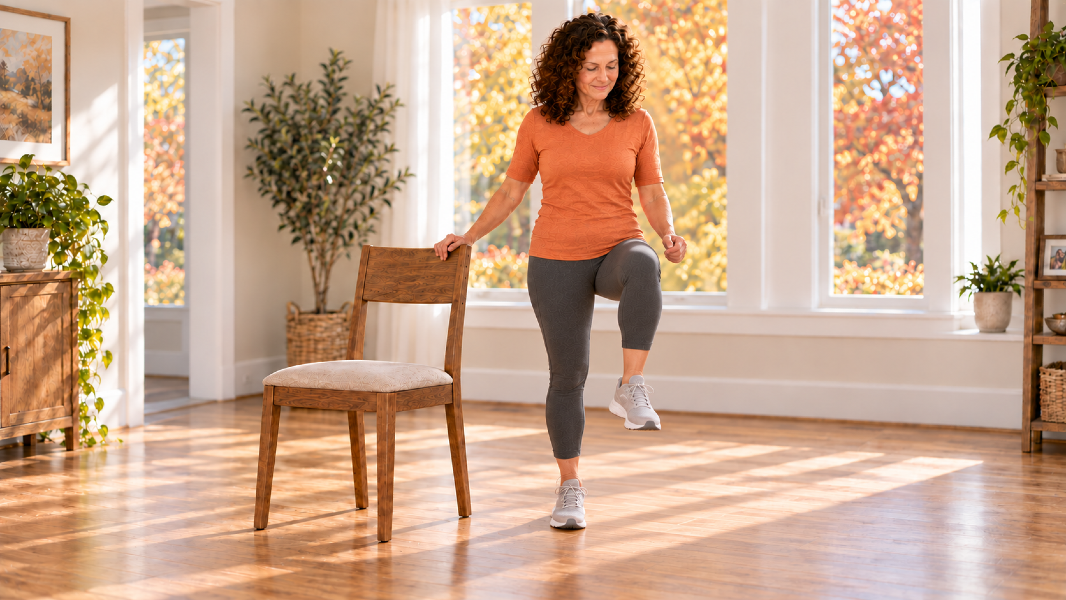
3. Supported Marching — 40 Seconds
Stand tall beside or facing your support.
Slowly lift one foot.
Lower it.
Then lift the other.
This isn't about marching quickly or lifting your knees as high as possible.
Focus on controlling the moment when your weight is supported primarily by one leg.
Rest/reset: 20 seconds.
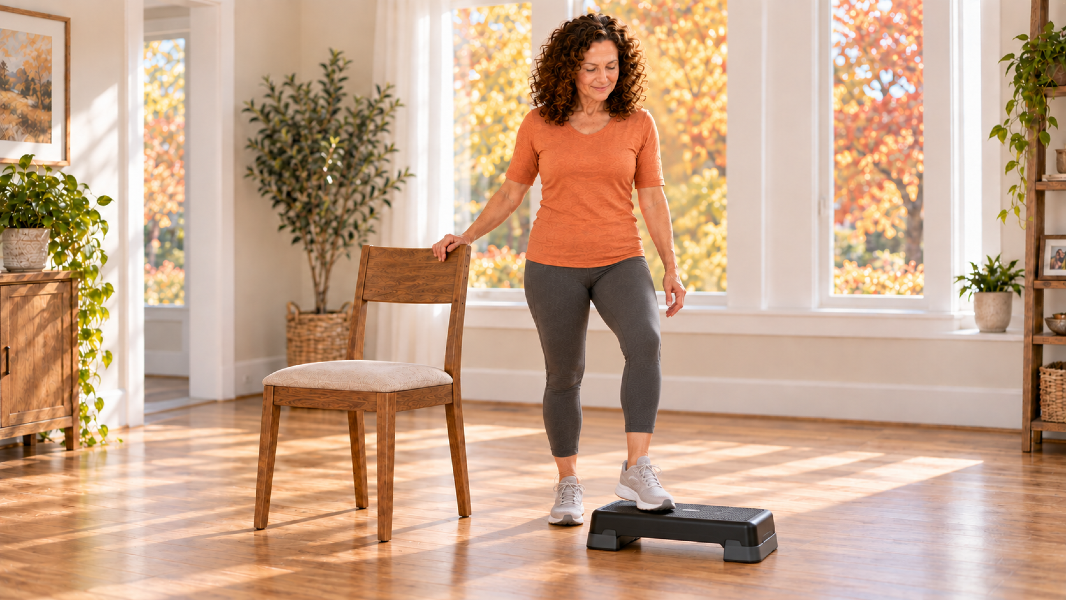
4. Low Step Taps — 40 Seconds
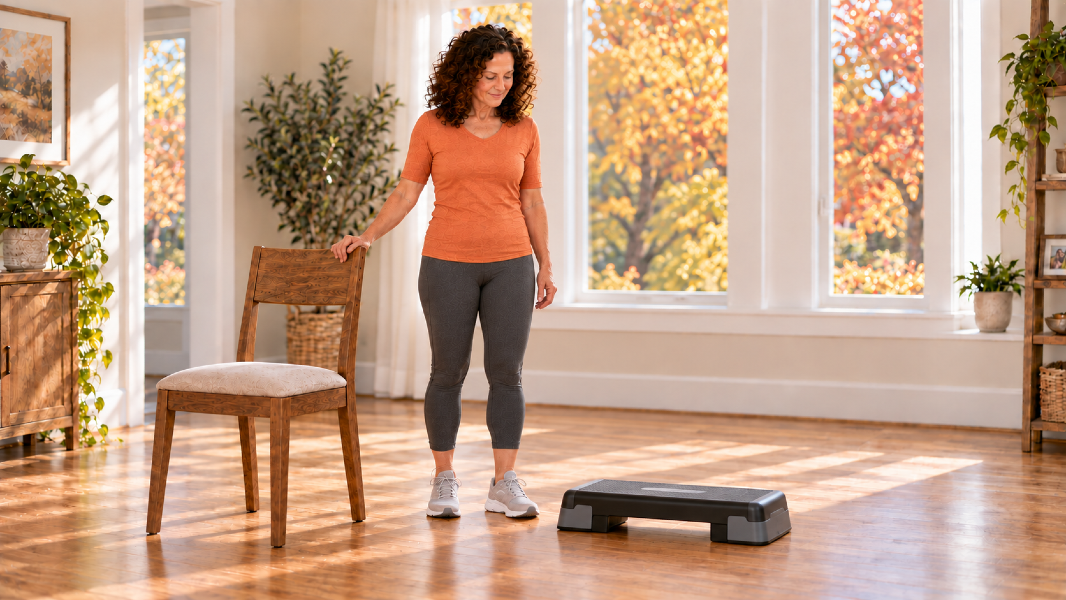
Place a low, stable step or similarly secure raised surface in front of you.
Keep a hand near a railing, counter, or sturdy support.
Tap one foot onto the step and return it to the floor.
Alternate sides.
Move slowly enough that you remain in control.
Rest/reset: 20 seconds.
5. Supported Single-Leg Hold — 40 Seconds
Stand beside the counter.
Shift your weight onto one leg.
Lightly lift the opposite foot from the floor.
Hold for several seconds.
Set it down.
Repeat on the other side.
Continue alternating.
There's no prize for removing your hand from the counter.
Use the support you need.
Rest/reset: 20 seconds.
Now repeat all five exercises one more time.
How to Progress Safely
When an exercise starts becoming easier, don't immediately make it dramatically harder.
First try using slightly less fingertip pressure on your support.
That's a progression.
Then you might increase the quality or steadiness of the movement.
Only after you're comfortable would I consider increasing the duration.
What I would not do is close my eyes just to make the exercise harder.
Vision is an important part of balance, and removing it substantially changes the challenge.
Pay Attention to Which Side Feels Different
One of the most useful things about simple exercises is that they give us information.
Maybe one leg feels steadier than the other.
Maybe step taps are easy but heel-to-toe stance is surprisingly challenging.
That's useful.
You don't have to judge it.
Just notice it.
That's the movement that may deserve a little more practice.
Your Challenge This Week
Do this routine twice.
Ten minutes each time.
And after each session, ask:
Which movement required the most support?
That's where I'd focus next.
As always, work within your own abilities. If you have significant balance problems, recent falls, dizziness, a neurological condition, or another medical issue affecting balance, individualized guidance from an appropriate healthcare professional or physical therapist is the better starting point.
Stop exercising if you develop concerning symptoms such as chest discomfort, severe dizziness, unusual shortness of breath, or sharp pain.
We're building confidence.
Not testing our limits.
Join Plant Based Flex free if you'd like new Thrive Beyond 60 movement, food, and practical healthy-living posts delivered to you.
Disclaimer:
This content is for informational purposes only and is not medical advice. Always consult your healthcare provider before making changes to your diet, supplements, or lifestyle, especially if you have existing conditions or take medication.
💌Want plant-based tips each week
Join the Plant Based Flex newsletter. It’s free, and when you confirm your email I’ll send you a 7-Day Kickstart Wellness Bundle to help you thrive beyond 60.